AI Product
Zizta
AI SEO platform
An AI research and content system that drafts, critiques and grades briefs against real SERP data - with evaluation baked into the pipeline.
- Laravel
- React
- OpenAI
- PostgreSQL
- Redis
- Cloudflare

The problem
AI content tools produce confident, generic drafts. Teams could not tell which output was actually good before publishing it.
Business challenge
Make quality measurable: every generated brief needed a score a human could trust and argue with.
Research
Built a labelled set of 600 briefs graded by editors, then tuned an evaluation rubric until the model agreed with editors 90% of the time.
Planning
A multi-stage pipeline - retrieve, draft, critique, revise, score - with each stage cached, observable and independently replaceable.
Architecture
- Queue-driven generation pipeline with per-stage retries
- Vector retrieval over crawled SERP and client corpus data
- Model routing: cheap models for extraction, strong models for critique
- Full prompt/response logging for evaluation and cost attribution
Database design
PostgreSQL with pgvector for embeddings, plus a run table capturing every stage's input, output, tokens and cost.
API flow
- 1 User submits a keyword and target audience
- 2 Retrieval stage assembles SERP context and internal corpus chunks
- 3 Draft → critique → revise loop runs until the score plateaus
- 4 Final brief and its score card are returned and stored
Implementation
- Started with evaluation harness before writing a single prompt
- Streaming UI so users watch reasoning instead of waiting
- Per-workspace cost caps to keep unit economics predictable
Key features
- SERP-grounded content briefs
- Automated critique with a transparent score card
- Workspace-level cost and usage controls
- Streaming generation UI
Performance
- Model routing cut token spend without changing output scores
- Cached retrieval reduced repeat-run latency by 3x
Lessons learned
- Build the evaluation before the feature. It changes every later decision.
- Cheap models do 70% of the work if you route deliberately.
More case studies

SaaS Platform
Softedin
A delivery platform that turns a services business into a repeatable, measurable machine - pipeline, scoping, sprint delivery and invoicing in one system.
Read the case study
Realtime Platform
PEEQ
High-frequency location and asset tracking with live dashboards, geofencing and an event pipeline that stays calm under burst load.
Read the case study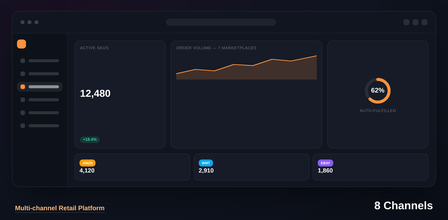
Contract Engagement
RocketDrop
The premier wholesale and distribution platform for Apple, iPhone and consumer electronics, selling the same inventory across Amazon, Walmart, eBay, Newegg, Groupon, Rakuten, BestBuy and Facebook Marketplace.
Read the case study